Anís del Mono (Badalona, part 1)
My home in Badalona is just five minutes from the beach. Walk down along streets of old houses and, just before reaching the sea, you’ll find yourself surrounded by modern blocks of flats where a phalanx of factories once stood. The oldest railway line in Spain, which you cross over the old brick footbridge, was originally built here in the 1840s. It brought industry to the coastal area at a time when no-one worried about the environment or what all this development would do to the beach. For over a century, it was the beating economic heart of the city, but now all the factories are gone, just the occasional chimney standing as a forlorn sentinel to mark Badalona’s manufacturing glory days. All gone, that is, except Anís del Mono.
My nose usually alerts me to the presence of their factory before I actually see it: the aroma of aniseed far more distinctive than any logo, even the famous trademark of the product made here. A century and a half ago, the whole of Badalona must have smelled of it, as it seems there were dozens of distilleries making anisette or aniseed liqueur. Anís del Mono, though, is the only one left.
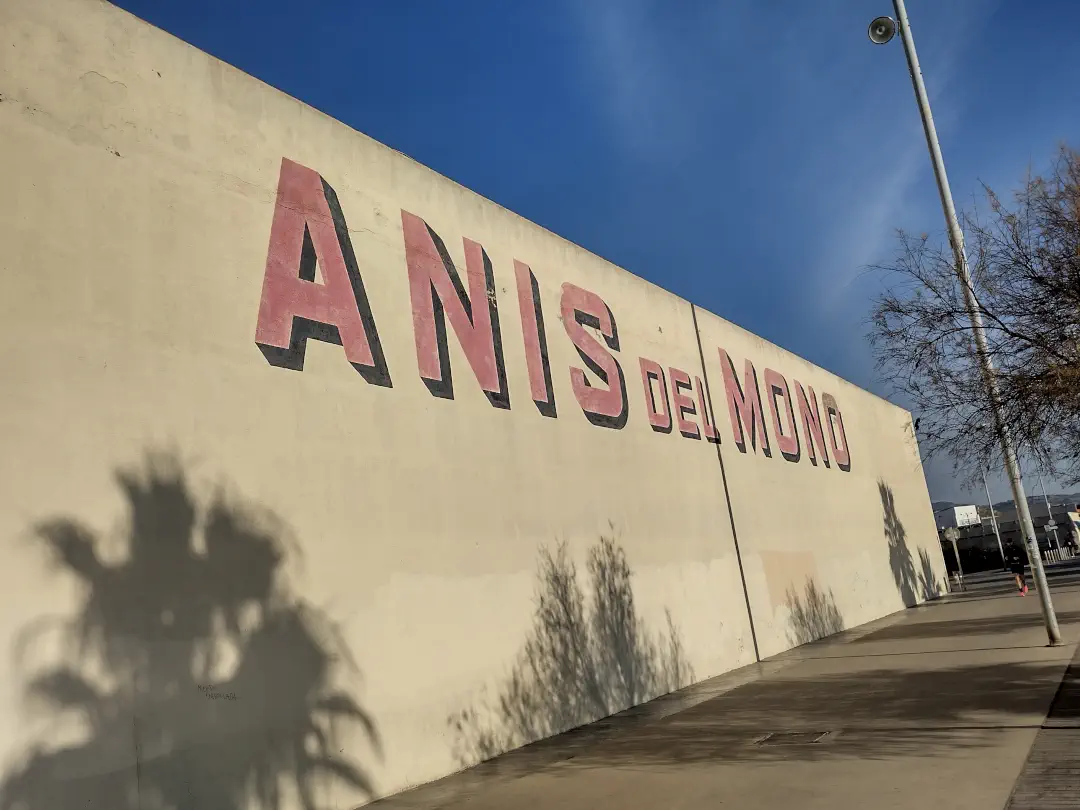
From the promenade beside the sea, the factory is unremarkable: a blank wall, simply bearing the name of the drink. Turn around, though, and your eye is drawn to a figure sitting at the beginning of a broken pier sticking out into the waves. This is Badalona’s Pont de Petroli, another relic of its industrial past, still closed to the public four years after a huge storm ripped part of it down. But it’s the statue at the beginning of the pier that interests us now.
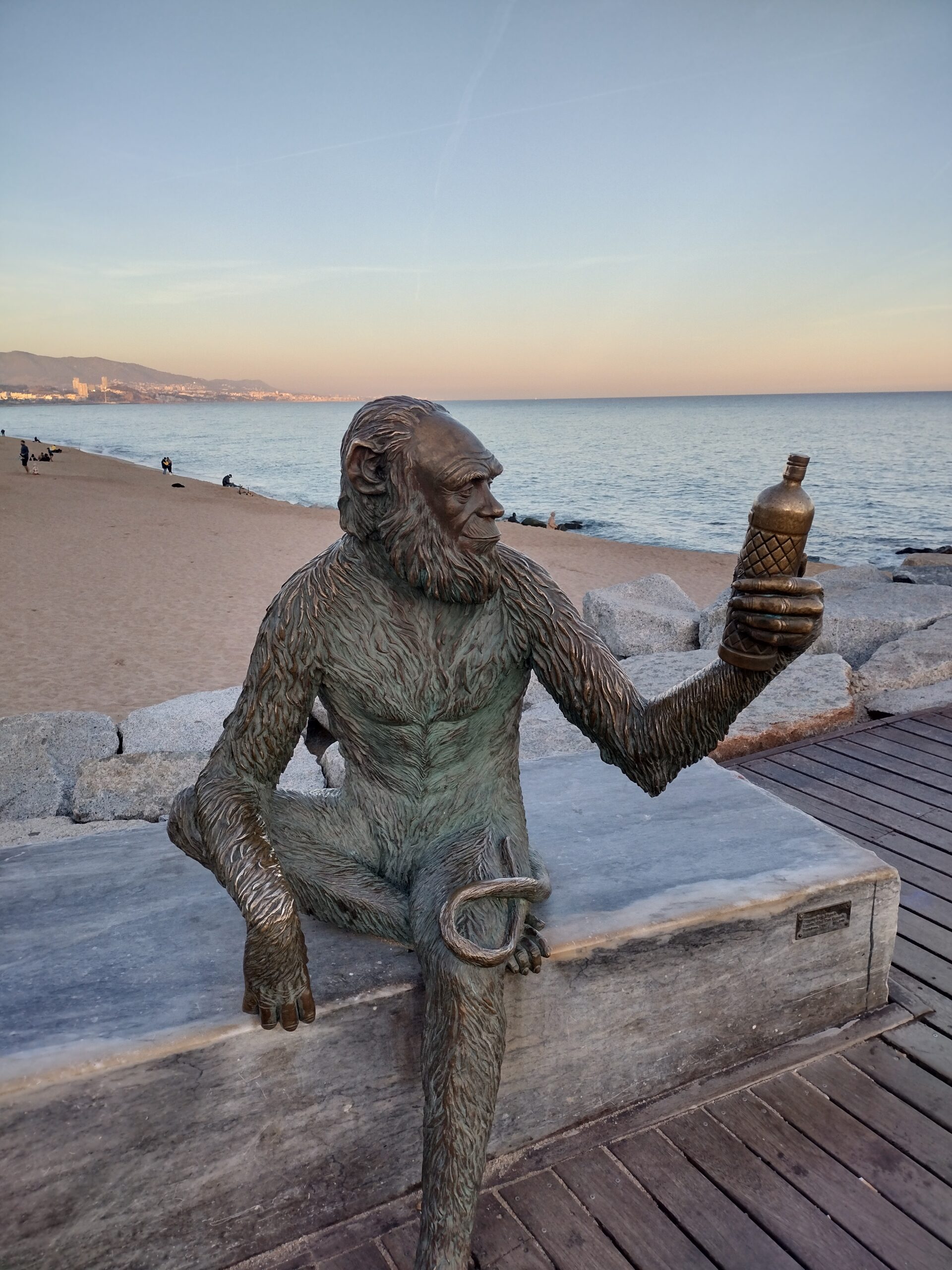
It represents an odd looking monkey which, without the hair all over its body, might appear almost human, particularly its face and sloping forehead. Sitting in relaxed pose, it fondly regards what looks like a cut-glass bottle held in its left hand. The metal of the bottle shines brightly, evidence of the constant flow of people who touch it as they have their photograph taken at this city landmark, created by the local artist Susana Ruíz Blanch.
The monkey is taken from the illustration on the label of Anís del Mono, almost unchanged since it was first introduced at the end of the 19th century. Even the spelling mistake on the label has been maintained (it says “Destillación Especial” when the Spanish word should have only one “l”), initially as a way of catching out 19th-century product fakers. But more of that later.
For now, we turn away from the monkey and walk round the side of the factory building, go through a door and, on a tour organised by Badalona museum, enter the factory itself. Until recently, the liqueur itself was made here, but now all that is distilled is the flavouring – the essential oil of the aniseed, which is why the smell is so powerful. For half a century now, Anís del Mono has belonged to the Osborne group based in Andalusia, which is where the drink is now made, using the flavouring still produced beside the sea in Badalona in spectacular copper stills encased in wood from a plant which, in Catalan, goes by the splendid name of matafaluga.
This is a Modernista factory, built at the beginning of the 20th century in the style (a Catalan version of French Art Nouveau) favoured by the likes of Antoni Gaudí and Josep Puig i Cadafalch, although this particular example was designed by a local architect, Joan Amigó. All attractive curved shapes and coloured glass, it makes buildings created for manufacturing a great deal more pleasant to look at than the brick leviathans of the Industrial Revolution or the glorified aluminium sheds we build for the same purpose nowadays.
The real glory of this factory, though, lies in its offices, which are still used today but appear to have survived almost unchanged since the 1900s: all dark wooden desks and glass display cabinets. They may look like antiques now, but there was a time when this was the cutting edge of the brand new sciences of advertising and marketing.
Here, the company keep the records of the competition held in 1897 to design an advertising poster for the drink entered by the big artistic names of the time on the Barcelona scene. It was won by Ramon Casas, probably the best known of all the Catalan artists of the period, with his painting of the monkey that gives its name to the liqueur, hand in hand with a fashionably dressed young woman.
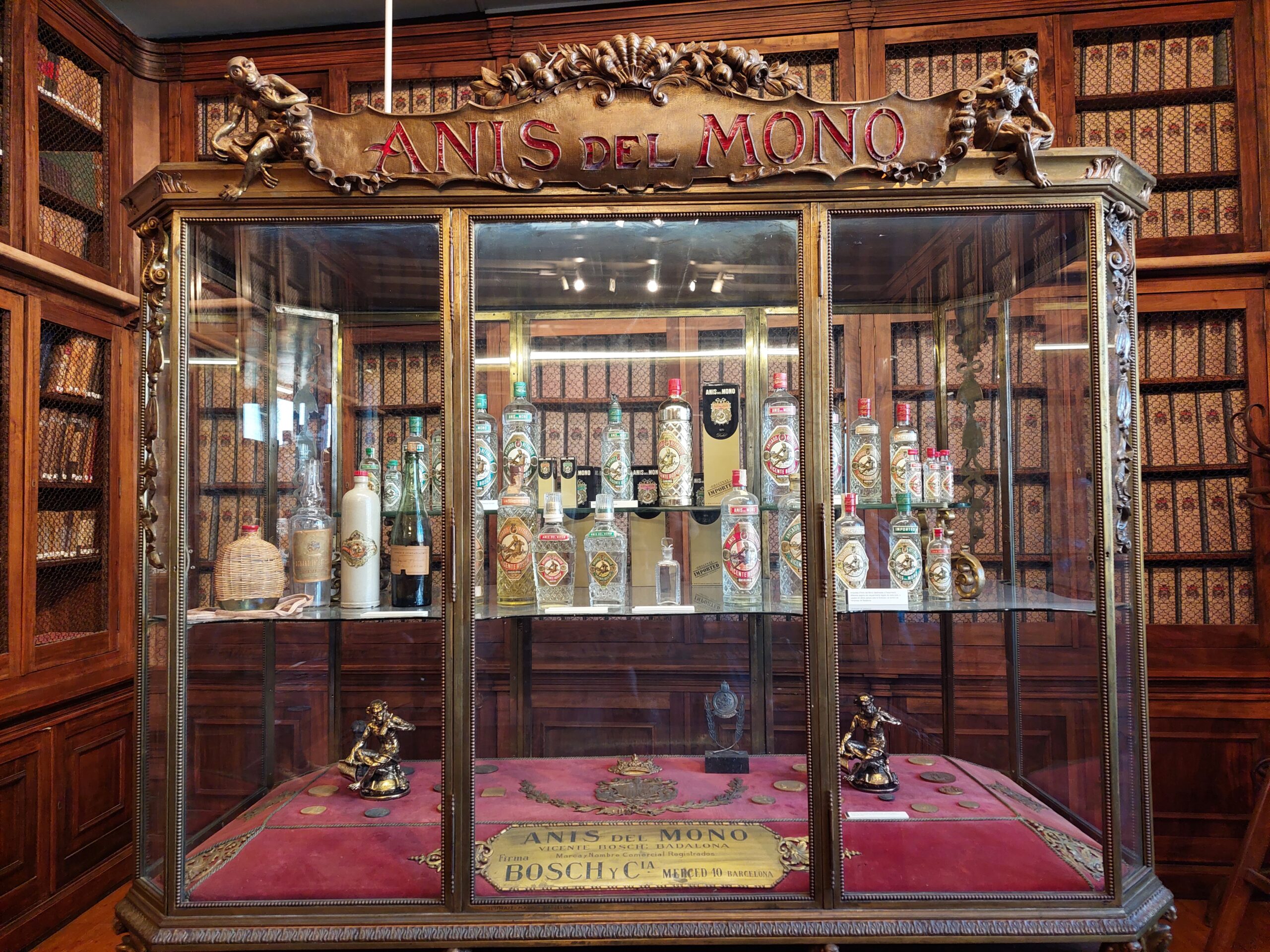
Also in the office is a cabinet full of antique bottles that offers an early case study in what would now be described as “branding”. Counterfeiting and copying of products were big problems in the late 19th century. So what better way to fight them, and to make customers remember your product, than distinctive packaging, in this case, a bottle? But what kind of bottle to use? Company owner Vicente Bosch found the answer in Paris when buying perfume for his wife. He believed the cut glass pattern on the perfume bottle could be adapted into a distinctive container for his liqueur. He found a manufacturer in Badalona who could do the job, and Anís del Mono’s famous bottle was born. It has changed very little ever since and has become an institution in Spain, where every Christmas drunken uncles use it as an impromptu musical instrument by rubbing a pencil up and down the indentations in the glass.
And then there’s that label, with the rather peculiar looking monkey – the one reproduced in statue form outside – bearing more than a passing resemblance to the great evolution theorist Charles Darwin. Its real meaning is a true mystery, with some claiming that Bosch was a fervent Darwinist while others seeing biting sarcasm in the representation of the scientist as a monkey together with the Spanish caption which translates as: “It’s the best. Science says so and I do not lie.” Somehow, the liqueur managed to have one foot in each camp in what at the time was a fiercely argued evolution debate.
Anís del Mono managed to achieve something modern-day marketers would tell you is impossible: creating a brand to last more than 150 years, as recounted in a beautiful book which I translated into English, produced jointly by Badalona Museum and the Osborne group for the landmark anniversary in 2020. Perhaps tastes have changed. Perhaps it is irretrievably an old person’s drink. But, after a century and a half, Anís del Mono still sells, and its factory still gently perfumes the sea air in Badalona, where the liqueur’s trademark has become a landmark in the form of a statue. It’s a feat of survival and adaptation that would surely delight the early Darwinists it either celebrates or mocks.
*If you would like to see the factory, regular guided tours are organised by Badalona Museum.