
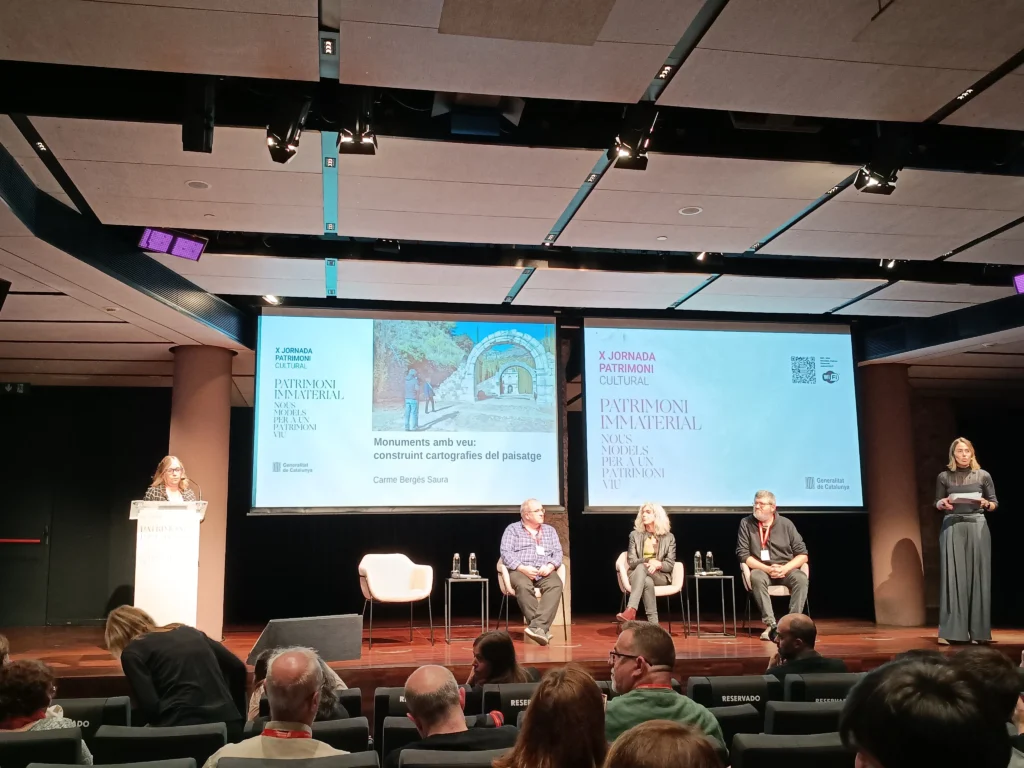
As its name suggests, there’s something about intangible cultural heritage that’s very difficult to pin down. It’s not just that it’s all about things that don’t exist in physical form: traditions, customs and knowledge rather than sites and monuments. It’s also because, by their very nature, they all need people to pass them on and perpetuate them. It makes conserving and supporting intangible cultural heritage a very different job from making sure that walls remain standing.
Last week, intangible cultural heritage was the subject of the 10th Cultural Heritage Conference organised by the Government of Catalonia’s heritage department and held in Barcelona. I attended and was fascinated by the way professionals in the field are trying to get to grips with the nebulous concept of intangible heritage. Because even the man who helped write the book that explains the idea for the United Nations agency in charge of granting World Heritage status to some of the most important examples of intangible heritage on the planet admits that some of the definitions are deliberately unspecific.
“The power of texts from UNESCO is vagueness and ambiguity,” Prof. Marc Jacobs, from the University of Antwerp told a roomful of delegates from museums and heritage centres all over Catalonia. “I like that because it makes things work.” Or at least it does at UNESCO, where consensus on everything, such as which pieces of heritage are named on the World Heritage list, is key. “The worst thing that can happen is if we have to have a vote” he said in his talk. “There are votes but that means consensus has failed.”
This is all very well at an international organisation, of course. But as these vague terms are translated into equally vague ones in other languages and passed down through national and regional legislation to real projects on the ground, ambiguity proves not to be such an an advantage. As Sara González, coordinator of the Spanish National Plan for Safeguarding Intangible Cultural Heritage admitted, one of the biggest problems of her job is the very ambiguity of the conventions and the legislation. Meanwhile, regardless of the fine but often not particularly useful words, real people are getting on with real projects to help ensure the continuation of traditional customs and knowledge. Gema Carrera, of the Andalusian Historic Heritage Institute, spoke of efforts being made to maintain ancestral agricultural practices in her region and Jordi Abella, the director of the Valls d’Àneu Ecomuseum in Catalonia talked about his organisation’s initiatives to maintain traditions in the Pyrenees.
Carme Bergés, head of Monuments and Sites for the Catalan Cultural Heritage Agency, made the crucial point that monuments themselves now need to be understood not only for their historical value for tourists but also as places of memory for people who have spent all their lives around them. Using the example of the largely ruined monastery of Escaladei in southern Catalonia, she explained how local people were asked for their memories of the site. Some had gone to school there, others had been married. Her aim is the creation of a sound archive, available on the internet, containing this type of material – an intangible element of tangible heritage – for a whole series of sites.
One of Catalonia’s most prestigious pieces of intangible heritage is the Patum festival held in Berga in the Pyrenees every May or June (it is linked to the religious festival of Corpus Christi) and recognised by UNESCO in 2005. The festival lasts several days and is difficult to describe for the uninitiated, but it involves dances in a packed town square featuring a series of traditional figures and large numbers of fireworks, many of them carried or worn by the participants. The historian and archivist Albert Rumbo, with close connections to Patum, made some interesting points about intangible heritage that now suffers from attracting too many people, a situation often blamed on tourists and sometimes on the UNESCO recognition itself.
He asked whether tourists could be the real problem, given that the population of the local area could fill the central square where the dances take place several times over. And he even questioned the very definition of tourist: is it someone from outside the local area? If so, how far outside? Where should the boundary be drawn? And can someone be considered a tourist if they actually participate in the festivities, as opposed to standing and watching? He also produced evidence showing that complaints about tourists at Patum go back at least as far as the 18th century. Nevertheless, the fact remains that this is a festival in danger of being choked, or forced into desperate measures, by its own popularity.
Perhaps a better example of how intangible heritage can be helped with a little recognition and some financial support comes from the Palm Weaving Museum at Mas de Barberans in southern Catalonia. This opened in 2010 and also includes a local rural development centre, but focuses on the traditional craft of weaving useful objects from palm fibres. As part of its activities, the centre has helped a group of local women maintain, publicise and teach the craft to others, in a classic example of keeping a traditional activity alive.
As Sara González had mentioned earlier, intangible heritage cannot be allowed to fossilise – if it is not passed on as a living thing, open to change and adaptation, it will die. And, while some may strive for UNESCO recognition, others are not interested in the bureaucracy involved in going down that route and just want to get on with doing the things they like doing. All the speakers, and the participants in the closing round table – Carles Freixes, the director of the Solsona Diocesan and County Museum; Agnès Bartolomé, a manager involved in various heritage projects; Jordina Boix, director of the Jacint Verdaguer House-Museum; and Emili Molins, of the Nargó Rafting group – implicitly accepted that the emphasis nowadays is not so much on attracting tourists as on making sure all kinds of heritage are relevant and useful to local communities. On that basis, perhaps the questions we should be asking would focus on precisely what is the point of striving so hard to achieve acceptance on national and international lists. Although presumably any answers would need to be phrased in suitably vague and ambiguous terms.